
Roulette Call Bets Explained: Voisins du Zéro, Tiers du Cylindre, Orphelins and Jeu Zéro, Chip by Chip
Spend an evening at a French or other European roulette table and you will hear players ask for “voisins” or “tiers” instead of placing chips one by one. These are call bets, also called announced bets. They are a shortcut for covering a block of the wheel with a fixed set of chips. This guide explains the four standard call bets, how many chips each one uses, what a win pays, and why none of them changes the odds.

What a Call Bet Is
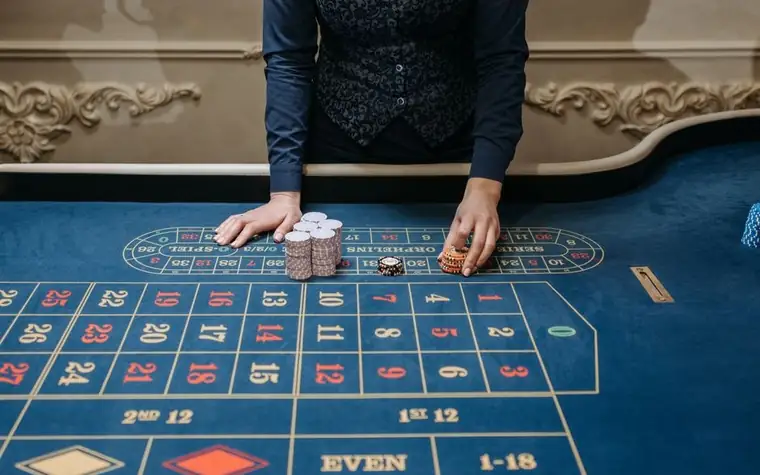
A call bet is a named pattern of chips placed on the layout by the dealer. You say the name, hand over enough money to cover every chip in the pattern, and the dealer places them for you. Each chip is an ordinary inside bet, usually a straight-up number, a split, a street or a corner. Nothing about the bet is special in how it pays. It is simply a faster way to place a group of standard wagers, and it is built around the order of numbers on a single-zero wheel.
Voisins du Zéro
“Neighbors of zero” covers 17 numbers that sit together on the wheel from 22 through 25, including the zero. It takes nine chips: two on the 0-2-3 trio, two on the 25-26-28-29 corner, and one each on the splits 4/7, 12/15, 18/21, 19/22 and 32/35. A trio pays 11 to 1 and a corner pays 8 to 1, so a hit on the trio nets more than a hit on a single split. Because it needs nine chips, the minimum outlay is nine times your chip value.
Tiers du Cylindre
“Thirds of the wheel” covers 12 numbers on the opposite side of the wheel from zero, running from 27 around to 33. It uses six chips, one on each of the splits 5/8, 10/11, 13/16, 23/24, 27/30 and 33/36. Every chip is a split, so any winning number pays 17 to 1 on one chip. With one unit per chip you stake six units, win 17 on the hit and lose the other five, for a net gain of 12 units. Any other number loses all six.
Orphelins
“Orphans” are the eight numbers left over once voisins and tiers are counted: 1, 20, 14, 31, 9, 17, 34 and 6. They sit in two small groups on either side of the other blocks. The bet takes five chips: a straight-up on 1 and splits on 6/9, 14/17, 17/20 and 31/34. A hit on the straight number pays 35 to 1, while a hit on a split pays 17 to 1. Together, the three bets above cover all 37 numbers exactly once, which is why the wheel is often split this way.

Jeu Zéro
“Zero game” is the smallest of the four. It covers seven numbers close to the zero pocket: 12, 35, 3, 26, 0, 32 and 15. It takes four chips: a straight-up on 26 and splits on 0/3, 12/15 and 32/35. Some casinos list it as “zero spiel.” Players like it because the outlay is low, but it covers fewer numbers, so it hits less often. Always confirm the exact chip pattern with the dealer, since a few venues use slight variations.
The House Edge Stays the Same
On a European wheel every bet carries the same built-in edge of 1 in 37, about 2.70 percent, no matter how many chips you place or which numbers you cover. A call bet is a bundle of normal bets, so its overall edge is also 2.70 percent. Covering more numbers raises your chance of winning on a spin but lowers the payout in proportion. Our European vs American roulette guide shows why the double-zero wheel is worse, and our La Partage and En Prison guide covers the only rules that reduce the edge, on even-money bets.
Practical Notes Before You Play
Call bets are mainly a European and French-style custom. Many American-style tables with a double-zero wheel do not offer them, or offer only “neighbors” bets in a different form, so ask before you assume. Also note that you must hand the dealer the full amount for the pattern, and that table minimums apply per chip. Wait for the previous spin to finish before announcing, and check the payout rules posted at the table. Our house edge by game guide compares the cost of other games, and the casino section has more rules explainers.
Keep It Entertainment
Call bets make a spin feel organized, but no pattern can predict where the ball lands or give you an advantage. Set a budget before you sit down, and treat what you spend as the price of the evening.
General information only, not gambling advice; rules, minimums and chip patterns vary by casino. Gambling is for adults in places where it is legal: 21+ in the United States and 18+ in the United Kingdom. Never bet more than you can afford to lose. See our responsible gambling page if it stops feeling like fun.
All content is fact-checked under our editorial standards.